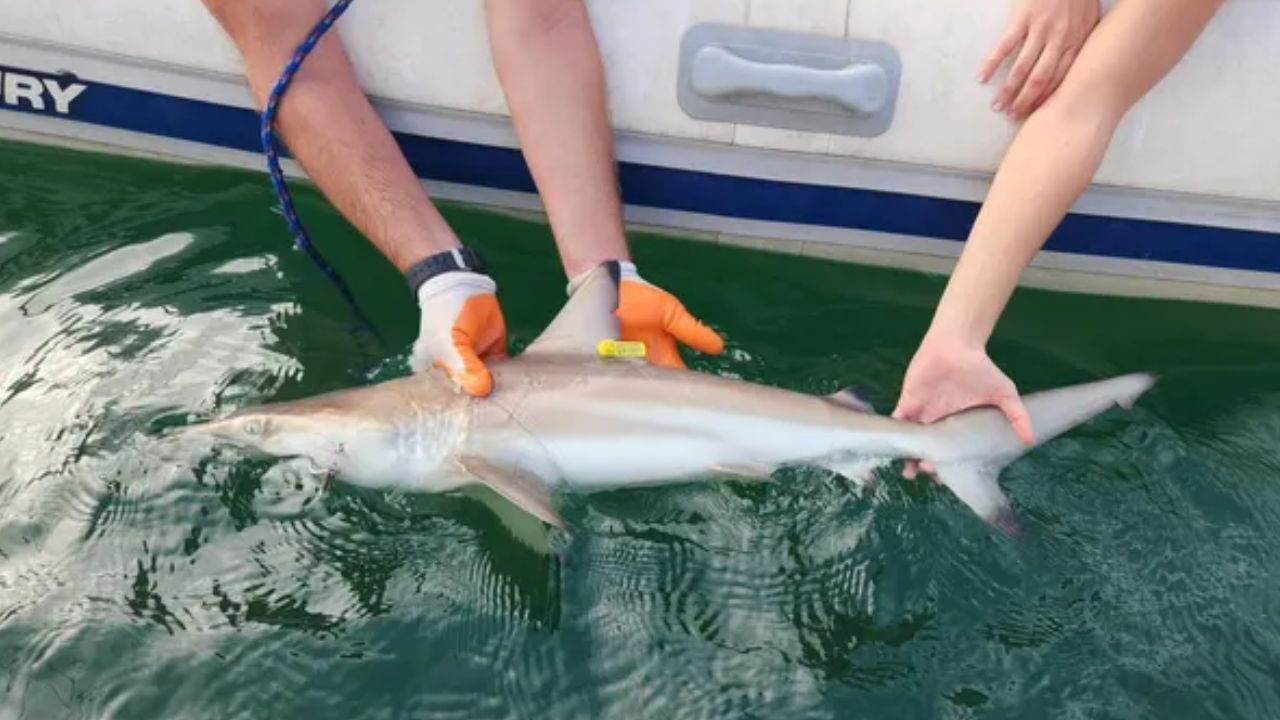
Hilo, Hawaii — Marine researchers have made a groundbreaking discovery after identifying the first known nursery habitat for blacktip sharks in Hawaiian waters.
The finding, published in a peer-reviewed scientific journal, is giving scientists a better understanding of how young sharks survive during the earliest and most vulnerable years of their lives while also highlighting the importance of protecting Hawaii’s coastal ecosystems.
Researchers Tracked Young Sharks for Nearly Two Years
The discovery was made by University of Hawaii graduate student Lauren Moe, her thesis advisor Jason Turner, and fellow researchers.
Their study, published in Frontiers in Marine Science, focused on oceanic blacktip sharks living in Hilo Bay on Hawaii’s Big Island.
To better understand the sharks’ movements, researchers fitted juvenile sharks with acoustic transmitters that allowed scientists to monitor their locations between July 2022 and January 2024.
The tracking data revealed that young blacktip sharks remained in Hilo Bay throughout the year, with activity reaching its highest levels between March and August.
According to the researchers, these movement patterns strongly support the conclusion that Hilo Bay serves as the first documented blacktip shark nursery in Hawaiian waters.
Why Shark Nurseries Matter
Scientists say nursery habitats play a critical role in helping young sharks survive. These protected coastal areas provide food, shelter, and safer conditions while juvenile sharks grow before venturing into deeper ocean waters.
Jason Turner, an associate professor of marine science at the University of Hawaii at Hilo and co-author of the study, said protecting these habitats is just as important as addressing threats such as overfishing.
He explained that while many people focus on fishing-related dangers facing sharks, habitat destruction caused by coastal development, pollution, increased maritime traffic, and climate change can be equally damaging.
Researchers say preserving these environments is essential for maintaining healthy shark populations in the future.
Study Offers New Insight Into Blacktip Sharks
The researchers emphasized that the study focused on oceanic blacktip sharks, a species that is not generally considered aggressive toward humans, with shark bites involving the species remaining rare.
According to the published research, the sharks appear to spend their first several years almost entirely within Hilo Bay, making the area especially important during the earliest stages of their development.
The study also noted that environmental changes could significantly affect the availability of nursery habitat, potentially influencing where young sharks are able to live and grow.
Scientists say these findings will help improve future conservation efforts aimed at protecting vulnerable marine ecosystems.
Modern Science Meets Native Hawaiian Knowledge
Researchers said the project combined Western scientific methods with Native Hawaiian cultural knowledge, creating a broader understanding of the marine environment.
Turner explained that traditional Hawaiian practices emphasize respect, gratitude, and reciprocity with nature, including ceremonial customs observed before conducting research.
According to the research team, incorporating these cultural perspectives helped strengthen the project’s connection to the local environment while respecting longstanding Hawaiian traditions.
Research in Hilo Bay Continues
Following the discovery, researchers are expanding their work to examine 15 years of shark and ray population trends in Hilo Bay.
Scientists hope the long-term research will provide additional insight into how environmental conditions, habitat changes, and conservation efforts influence marine wildlife over time.
The discovery of Hawaii’s first known blacktip shark nursery represents an important milestone for marine science and could play a key role in protecting one of the state’s most valuable coastal ecosystems for generations to come.
What do you think about this discovery? Should more coastal nursery habitats receive stronger environmental protections? Share your thoughts in the comments below.