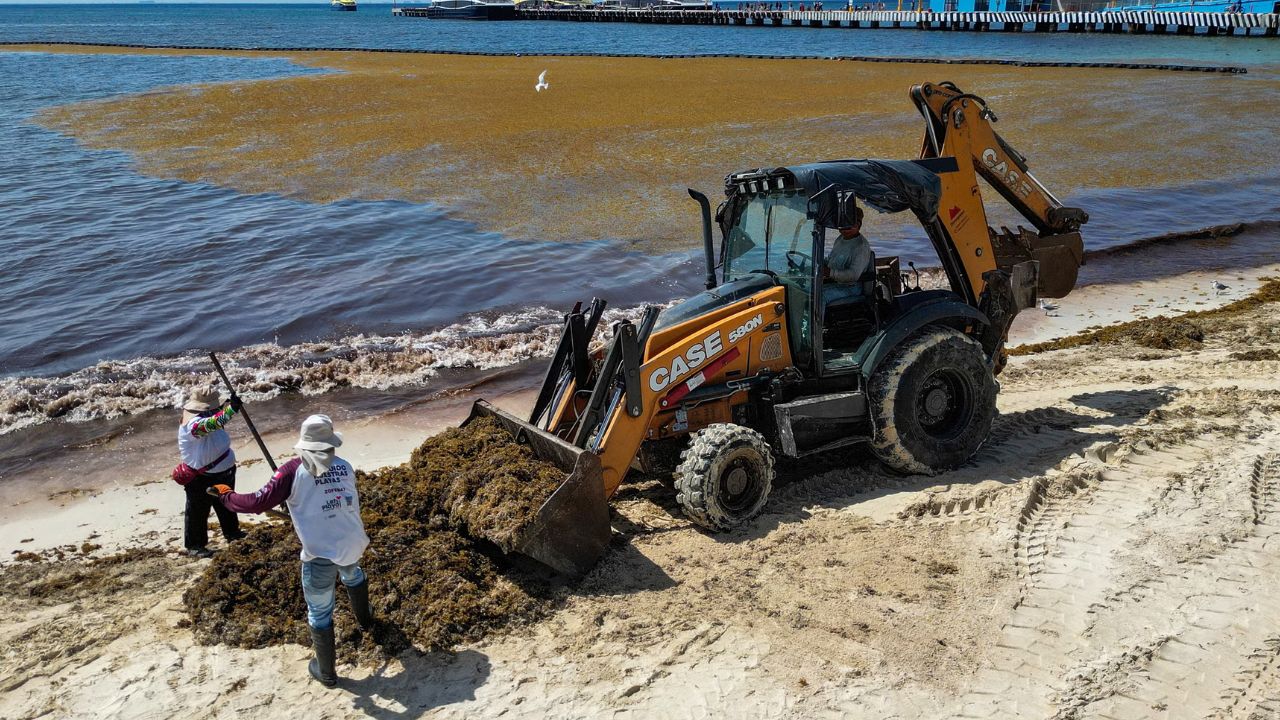
Miami, Florida — Record amounts of sargassum are piling up along Miami’s beaches, creating an increasingly difficult challenge for residents, tourists and crews tasked with clearing the shoreline. As workers struggle to keep pace with the waves of smelly seaweed washing ashore, researchers are looking at an unusual possibility: turning the environmental nuisance into a useful resource.
Miami Crews Struggle With Growing Sargassum Problem
Sargassum is a naturally occurring brown seaweed that floats across the ocean in enormous masses before reaching coastal areas. Florida, Texas and Louisiana are among the states regularly affected, while the seaweed has become a recurring issue across the Caribbean Sea, Gulf of Mexico and Atlantic Ocean.
In Miami Beach, city workers have been working around the clock to remove the material from the shoreline. But the sheer volume can make the cleanup effort feel endless, with new seaweed arriving as crews work to clear what is already there.
The problem is not simply about appearance.
As sargassum decomposes, it can release hydrogen sulfide gas, creating the distinctive rotten-egg smell associated with large accumulations of the seaweed.
Decomposing Seaweed Can Create Health Concerns
According to health officials, exposure to hydrogen sulfide can irritate the eyes, nose and throat and may be particularly concerning for people with asthma and other respiratory conditions.
Sargassum can also contain arsenic, heavy metals, organic contaminants and marine debris, creating additional complications when communities try to collect and reuse the material.
That means simply finding a new use for the seaweed is not enough. Researchers must first determine how to process it safely and consistently.
Researchers See Potential in Black Soldier Fly Larvae
A team from the University of Miami Rosenstiel School of Marine, Atmospheric and Earth Science is exploring whether black soldier fly larvae could play a role in the solution.
The young insects naturally consume organic material. Researchers believe they could potentially help convert beach waste into products such as fish food and fertilizer, creating a possible connection between sargassum cleanup, aquaculture and agriculture.
“Our goal is not just to provide a solution to reducing sargassum impacts to our shoreline, but to help redesign Florida’s response to it,” Professor Daniel Benetti, who is leading the project, said.
Early Experiment Shows Promising Results
As part of the research, scientists tested five different waste mixtures containing materials including kitchen scraps, agricultural produce, salmon farming waste and remains from salmon processing.
Researchers placed 200 black soldier fly larvae into each mixture and monitored them for 15 days.
All five diets supported larval growth, while survival rates remained high, ranging from approximately 94% to 99%. However, the experiment did not actually test sargassum.
Instead, researchers say the results provide a foundation for future experiments that could examine whether the larvae can safely process seaweed and other coastal waste.
Biggest Challenge May Be Contaminants
Before such a system could be used on Miami’s beaches, researchers have significant hurdles to overcome.
One of the biggest questions is how to reduce or control contaminants such as arsenic and heavy metals that may be present in collected sargassum.
A commercial-scale coastal processing system would also have to deal with huge and unpredictable amounts of wet seaweed while controlling moisture, temperature, disease-causing microbes, unwanted chemicals and overall product quality.
Researchers envision eventually developing climate-controlled units capable of processing the material on a much larger scale.
Miami’s Sargassum Cleanup Comes With a Huge Price
The financial incentive for finding a solution is substantial.
The Environmental Protection Agency estimates Miami-Dade County spends about $35 million annually collecting, transporting and disposing of sargassum.
If researchers can safely transform even part of that waste into useful products, the approach could potentially reduce disposal costs while creating new opportunities in aquaculture, agriculture and other bio-based industries.
“Instead of treating it as waste, our scalable system will convert it into valuable products for aquaculture, agriculture and emerging bio-based industries,” Benetti said.
For now, Miami’s beaches remain on the front line of the sargassum problem. But researchers hope that what currently looks like an expensive coastal burden could eventually become part of a new circular economy.
“We’re turning an environmental burden into a coastal value solution,” Benetti said.
What do you think about turning sargassum into useful products instead of simply sending it to the landfill? Share your thoughts in the comments below.