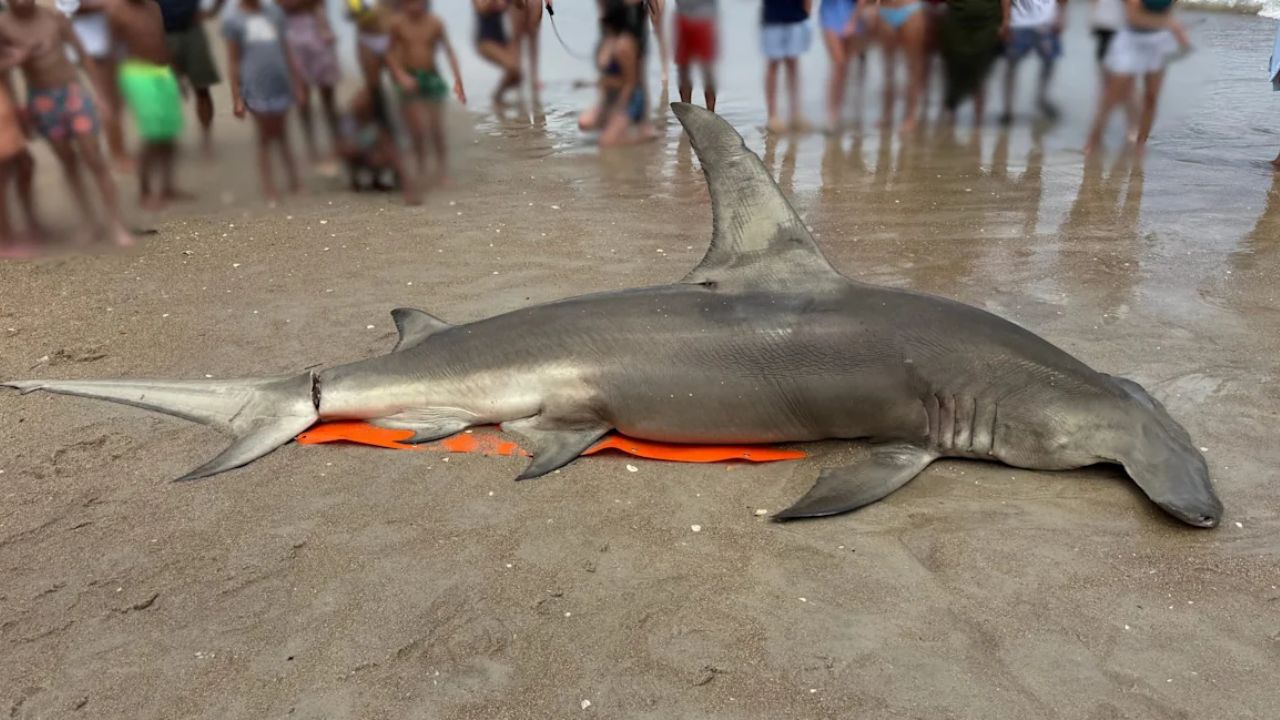
Carolina Beach, North Carolina — Beachgoers in North Carolina were met with a remarkable and somber sight after a 14-foot female great hammerhead shark washed ashore on Carolina Beach, prompting marine conservationists to launch an investigation into what caused the massive predator’s death.
The discovery drew attention from researchers and local authorities, who worked together to examine and safely remove one of the largest shark species found in the Atlantic Ocean.
Shark First Spotted in the Surf Before Washing Ashore
According to the North Carolina Shark Conservancy, the shark was first reported through the organization’s hotline at approximately 3 a.m. Sunday, after residents noticed the animal repeatedly appearing in the surf.
Hours later, at around 1:20 p.m., the shark washed onto the beach just north of the Carolina Beach Pier, where it remained until conservation volunteers arrived.
The organization dispatched trained volunteers to document the rare find and begin collecting scientific data.
Researchers Collected Samples for Scientific Study
Once on scene, volunteers recorded measurements, photographs, and biological samples from the shark.
The collected material will be used for genetic research and educational purposes, helping scientists better understand great hammerhead sharks and their populations along the Atlantic coast.
Because of the shark’s impressive size, the recovery required assistance from several local agencies.
The Carolina Beach Fire Department and Carolina Beach Police Department worked alongside conservation volunteers to safely remove and dispose of the animal.
Cause of Death Remains Under Investigation
Officials have not determined the shark’s exact cause of death.
However, researchers observed a deep laceration near the base of the shark’s tail, an injury they believe may have affected its ability to swim.
They also noted fresh puncture wounds around the shark’s mouth that appeared to be consistent with fishing gear.
At this stage, authorities have not concluded whether either injury directly caused the shark’s death, and no official findings have been released.
Unexpected Hammerhead Shark Sighting Off Rhode Island Marks a Major Milestone in Shark Research
Great Hammerheads Are Among the Ocean’s Largest Sharks
The great hammerhead is recognized as the largest species of hammerhead shark and belongs to the Sphyrnidae family.
According to marine experts, female great hammerheads typically grow between 16 and 20 feet long, while males are generally smaller.
The 14-foot female found at Carolina Beach was therefore a mature but not unusually large individual for the species.
Great hammerheads are commonly found in warm coastal and offshore waters throughout much of the world.
Species Ranges Along the Atlantic Coast
In the western Atlantic Ocean, great hammerhead sharks are found from North Carolina south to Uruguay, including the Gulf of Mexico and the Caribbean Sea.
Although sightings occur along the North Carolina coast, finding a shark of this size washed ashore is relatively uncommon, making Sunday’s discovery especially significant for researchers.
Scientists hope the samples collected from the animal will provide valuable information about the species’ health, genetics, and the challenges it faces in the wild as the investigation into its death continues.
What do you think may have caused this massive shark’s death? Share your thoughts respectfully in the comments below.