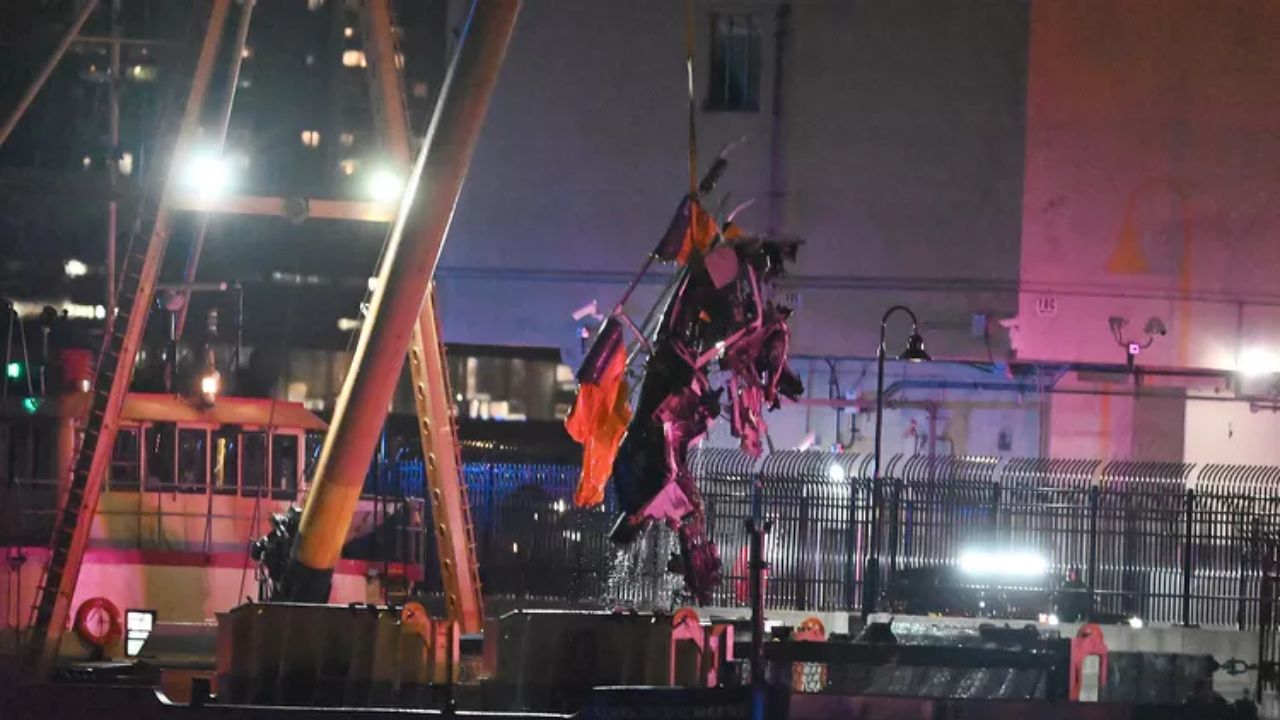
New York City, New York — Federal investigators say a bird strike was the likely cause of the devastating helicopter crash that sent a sightseeing aircraft plunging into the Hudson River last year, killing six people, including a Spanish family of five and the pilot.
The findings were released Thursday in a new report from the National Transportation Safety Board (NTSB), which outlines evidence gathered during the ongoing investigation into the April 2025 tragedy.
The crash shocked New York City and drew international attention after claiming the lives of an entire family visiting from Spain along with the helicopter’s pilot.
Bird Strike Evidence Found During Investigation
According to the NTSB, investigators discovered bird remains both inside the wreckage and at the crash scene, providing strong evidence that the helicopter struck a bird shortly before it went down.
The report states that pieces of the Bell 206L-4 helicopter’s main rotor blade and a severed bird wing were recovered on the ground and on nearby rooftops approximately 2,000 feet from where the main wreckage was eventually located.
Scientists at the Smithsonian Institution’s Feather Identification Lab examined samples collected from the wreckage, while additional laboratory testing conducted by the NTSB also confirmed the presence of bird remains.
Investigators say the findings support the conclusion that a bird strike likely played a critical role in the fatal accident.
Witness Reported Seeing Large Flock of Geese
The investigation also included statements from witnesses who were near the Hudson River shortly before the helicopter crashed.
One witness told investigators that a large flock of geese had taken flight only minutes before the accident.
“The geese were big and there were many of them. When the helicopter went bang, I immediately thought it was a bird strike,” the witness told NTSB investigators.
The witness account closely matched the physical evidence later recovered from the crash site.
Helicopter Broke Apart Before Hitting the Water
A previous NTSB report released in May 2025 revealed surveillance footage showing the sightseeing helicopter flying south before it suddenly separated into three major sections in midair.
Investigators later recovered the helicopter’s fuselage, engine, main rotor system and tail boom from the Hudson River.
According to the report, the fuselage was found upside down in about six feet of water, while other sections of the aircraft were recovered from depths of approximately 30 feet.
Additional debris was discovered floating in the river and on a rooftop in nearby Hoboken, New Jersey.
Report Highlights Additional Findings
The investigation also found that the helicopter was not equipped with video or flight data recording devices, limiting investigators’ ability to reconstruct the aircraft’s final moments.
Although pilot Seankese Carrell Johnson was photographed before takeoff wearing smart glasses capable of recording video and audio, the device was never recovered.
Federal investigators also noted that Johnson had returned to work that day after completing a scheduled 10-day break, and the fatal sightseeing trip was the eighth flight he had operated that day.
The crash claimed the lives of Johnson and Agustín Escobar, his wife Mercè Camprubí Montal, and their three children, ages 10, 9 and 4.
During the family’s funeral service held on April 22, 2025, Mercè Camprubí Montal’s father reflected on the heartbreaking loss.
“We have been in pain for the last 11 days, but they will always remain in our memories and remind us from up high to never lose our ability to smile.”
While investigators have identified a bird strike as the likely cause of the tragedy, the NTSB’s investigation remains ongoing as officials continue reviewing all aspects of the crash.
What are your thoughts on the NTSB’s findings? Should additional safety measures be required for sightseeing helicopters operating in areas with frequent bird activity? Share your thoughts respectfully in the comments below.