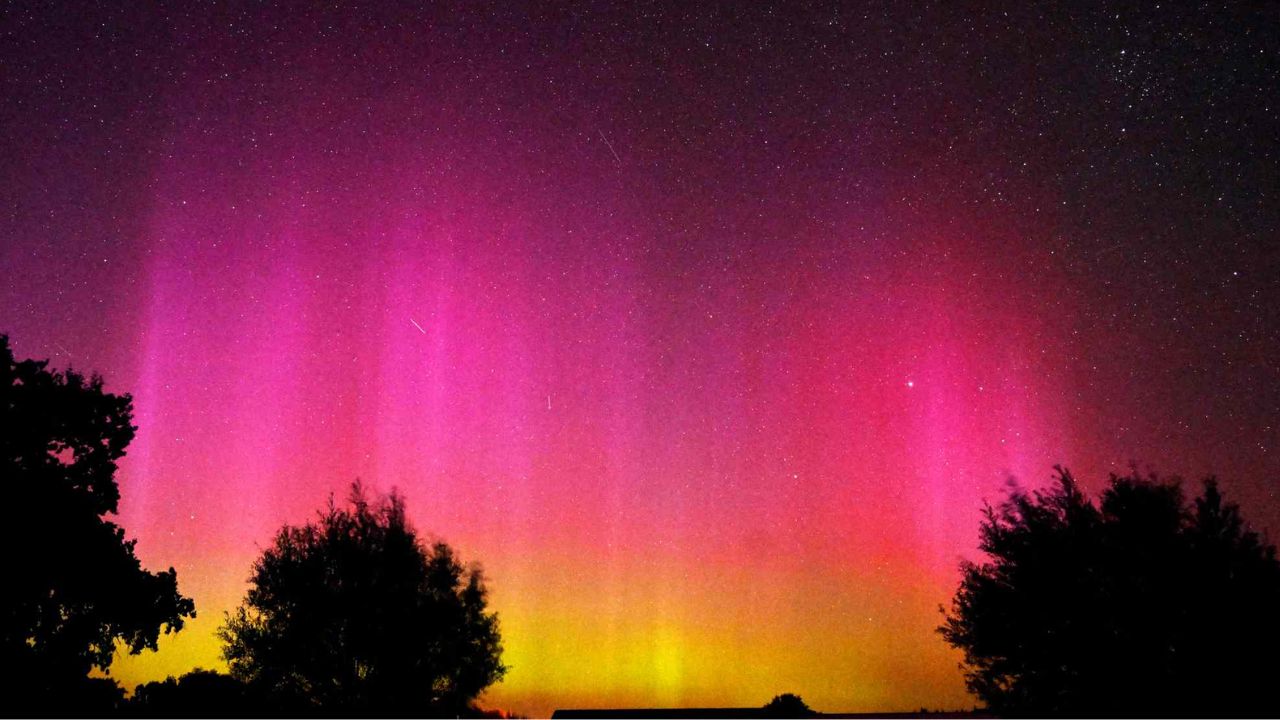
United States — Skywatchers across parts of the northern United States could be treated to a rare summertime display of the aurora borealis, as solar activity may bring the northern lights into view across as many as 19 states overnight.
The possible celestial event comes as a coronal mass ejection (CME) released from the sun last week approaches Earth, potentially triggering a G1 (minor) or even G2 (moderate) geomagnetic storm. If conditions develop as forecast, observers near the U.S.-Canada border could see the colorful lights dancing across the northern horizon.
Adding to the spectacle, the potential aurora coincides with the rise of the full Strawberry Moon, creating the possibility of an unforgettable night sky.
Solar Storm Could Trigger Aurora Display
According to space weather forecasters, the northern lights are produced when charged particles from the sun interact with Earth’s magnetic field and atmosphere.
The current forecast stems from a coronal mass ejection that erupted from the sun on June 26. As the solar material reaches Earth, it could temporarily disturb the planet’s magnetic field and produce auroras farther south than normal.
While forecasters are not expecting a major geomagnetic storm, even a minor or moderate event could create faint aurora displays for parts of the northern United States.
Officials caution that solar storms can be difficult to predict, meaning visibility could change quickly depending on how the incoming solar material interacts with Earth’s magnetic field.
Best Time to Watch the Northern Lights
The best opportunity to see the aurora is expected after sunset Monday and into the early hours of Tuesday morning.
Because the exact arrival time of the solar storm remains uncertain, experts recommend monitoring the sky throughout the night.
Space weather forecasts typically become much more accurate once the incoming solar particles are detected by monitoring satellites positioned ahead of Earth, sometimes providing only 30 to 60 minutes of advance notice before aurora activity intensifies.
States With the Best Viewing Chances
The highest likelihood of seeing the northern lights will be in states closest to the Canadian border.
The best chances include:
- Washington
- Idaho
- Montana
- North Dakota
- South Dakota
- Minnesota
- Wisconsin
- Michigan
- Maine
Depending on how strong the geomagnetic storm becomes, skywatchers in the following states could also catch a glimpse:
- Oregon
- Wyoming
- Nebraska
- Iowa
- Illinois
- Indiana
- Ohio
- New York
- Vermont
- New Hampshire
Those living farther south may have a lower chance, but rapidly changing space weather conditions could briefly expand visibility.
Tips for the Best Viewing Experience
To improve your chances of spotting the aurora, experts recommend heading to an area with minimal light pollution and an unobstructed view of the northern horizon.
Open fields, rural locations, lakeshores, and elevated viewpoints generally offer the best visibility.
Allow your eyes at least 20 minutes to adjust to the darkness, and avoid looking at bright phone screens, which can reduce night vision.
Photography can also help reveal faint auroras that may not be easily visible to the naked eye.
Strawberry Moon May Add to the Nighttime Spectacle
The full Strawberry Moon will also be visible Monday evening, adding another eye-catching feature to the night sky.
Although the bright moonlight could make weaker auroras more difficult to see, it may also provide a dramatic backdrop if both phenomena become visible at the same time.
With favorable weather and a bit of luck, skywatchers across portions of the northern United States could witness one of the season’s most memorable nighttime displays.
Will you be heading outside to watch for the northern lights tonight? If you capture photos of the aurora or the Strawberry Moon, share where you saw them and what the view looked like in the comments below.