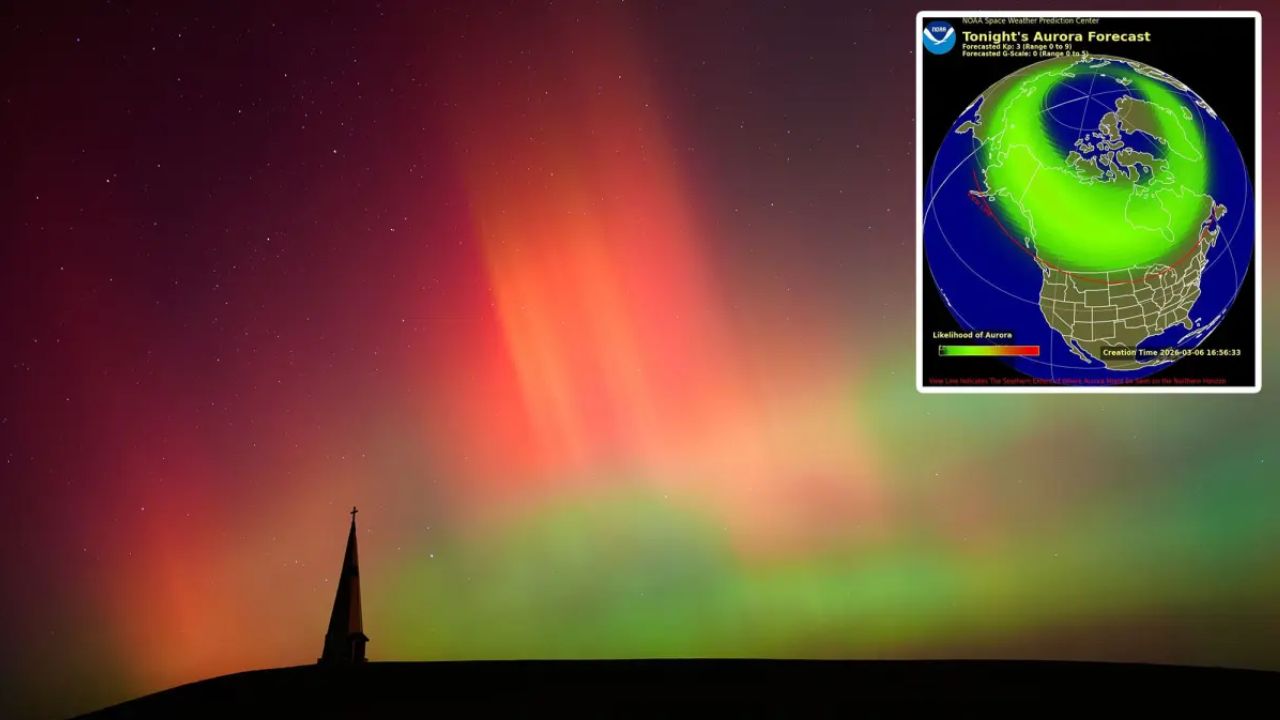
Washington, D.C. — Skywatchers across parts of the northern United States could have a chance to witness the northern lights late Tuesday night into Wednesday as increased solar activity is expected to trigger a minor geomagnetic storm, according to federal forecasters.
The anticipated display comes as a stream of high-speed solar wind from a large coronal hole on the Sun moves toward Earth. While the event is not expected to be as powerful as recent aurora displays caused by coronal mass ejections, experts say conditions could still be favorable for seeing the aurora borealis in several northern states.
Why the Northern Lights Could Appear Tonight
According to the National Oceanic and Atmospheric Administration (NOAA), a G1 (Minor) geomagnetic storm is likely as fast-moving solar wind interacts with Earth’s magnetic field.
Unlike stronger aurora events triggered by massive solar eruptions, this event is being fueled by a coronal hole—an area where the Sun’s magnetic field opens, allowing charged particles to escape into space at high speeds.
When those particles reach Earth, they can energize gases in the upper atmosphere, creating the colorful ribbons of light known as the aurora borealis.
Forecasters caution that solar wind conditions can change quickly, meaning the exact timing and intensity of the display remain uncertain.
10 States That Could See the Northern Lights
If weather conditions cooperate, the aurora may become visible in portions of the following states:
- Washington
- Idaho
- Montana
- North Dakota
- Minnesota
- Wisconsin
- Michigan
- Maine
- Vermont
- New Hampshire
The best opportunities will be in areas closest to the Canadian border, where geomagnetic activity is typically strongest.
However, visibility will also depend on cloud cover, local light pollution and the strength of the incoming solar wind.
Best Time and Tips for Viewing
Experts say the best chance to see the northern lights will come late Tuesday night into the early hours of Wednesday. Because July nights are shorter, viewers will have a smaller viewing window than during the winter months.
For the best experience, head to a location with dark, open skies away from city lights. Even during a minor geomagnetic storm, patience is important, as the aurora can appear as a faint glow before suddenly becoming brighter and more active.
Keeping an eye on real-time aurora forecasts and space weather updates can also help determine when viewing conditions are at their peak.
Health Officials Sound Alarm as Michigan Parasite Outbreak Tops 6,100 Cases Across 55 Counties
How to Capture the Aurora With Your Phone
Even if the display appears faint to the naked eye, your smartphone may be able to capture it more clearly.
Experts recommend enabling Night Mode or Long Exposure Mode and keeping the device completely still by using a tripod or placing it on a stable surface. Longer exposure times allow the camera to collect more light, making the colors of the aurora easier to see in photos.
While this is expected to be a relatively minor geomagnetic storm, clear skies and favorable solar wind conditions could still provide a memorable summer skywatching opportunity for millions of people across the northern United States.
Will you be staying up to watch the northern lights tonight? If you’re in one of the 10 states with a chance to see the aurora, let us know whether you spot it and share your photos or viewing experience in the comments below.