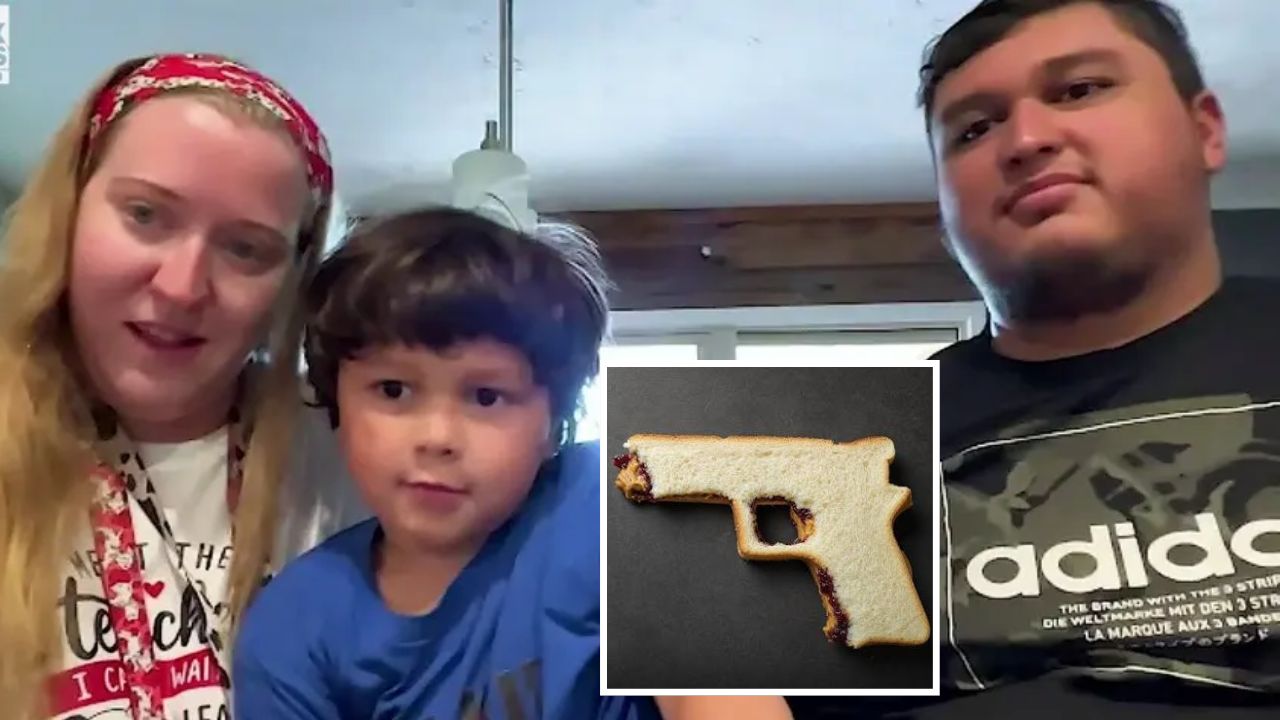
Fayette County, Georgia — The parents of a 6-year-old boy with autism are speaking out after their son was suspended from elementary school for biting a sandwich into the shape of a gun and pointing it at a classmate during lunch.
His family says the punishment reflects a larger problem with how schools handle children with developmental disabilities and behavior that may require teaching and support rather than repeated suspension.
Boy Suspended Over Sandwich Incident
John Medina, who was in first grade at Sarah Harp Elementary School in Fayette County, was suspended last March after the lunchroom incident.
According to his parents, Kristin and Juan “Ricky” Medina, John bit his sandwich into what appeared to be a gun shape and pointed it toward another student.
The incident resulted in disciplinary action under the school’s policies surrounding weapon-related behavior.
His parents say they understand that schools must take safety seriously, but they believe the response did not sufficiently consider John’s developmental needs.
John was diagnosed with level 1 autism at age 4 and was later diagnosed with ADHD. His parents say those conditions can make it harder for him to interpret social expectations and understand why certain behaviors may be viewed differently in a school environment.
Parents Say Suspensions Became a Pattern
The sandwich incident was not the first time John had faced disciplinary consequences. His parents say he has received roughly 15 suspensions and more than two dozen disciplinary actions since 2023.
They acknowledge that some incidents were serious enough to require intervention. John has reportedly pushed another student during physical education and once hit a classmate with a branch.
However, his parents say other disciplinary actions involved behavior they considered comparatively harmless, including hand gestures resembling guns and drawings involving weapons.
They said John even faced scrutiny after drawing a Thanksgiving picture showing a pilgrim shooting a turkey.
The family insists that weapons are not a subject they encourage at home and believes some of John’s fascination with such imagery may reflect ordinary childhood imagination combined with difficulty filtering behavior and speech because of his autism.
Family Says Punishment Hurt His Confidence
Kristin and Ricky say the repeated disciplinary actions have taken a significant emotional toll on their son.
According to his parents, John has begun referring to himself as a “bad kid” and has struggled with making friends and feeling accepted at school.
They say he has also become hesitant to attend school because he worries other children will laugh at him for making wrong choices.
For Kristin, the concern goes beyond individual suspensions. She said she wants her son to develop confidence, self-esteem and friendships rather than increasingly feeling singled out.
The family believes traditional punishment can sometimes be counterproductive for children with developmental differences, particularly if the child learns that certain behavior can result in being sent home from school.
Parents Say School Initially Denied IEP
The family also says they initially struggled to obtain appropriate educational accommodations for John.
According to Kristin, school officials initially refused to provide him with an Individualized Education Program, or IEP, because he was academically advanced and staff members did not recognize how his autism affected his school experience.
She said it took approximately a year and a half, along with numerous suspensions and a second evaluation that resulted in an ADHD diagnosis, before the school ultimately approved the IEP.
His parents say the additional support has made a difference.
John now has a behavioral plan and an aide during less structured periods, including lunch, recess and physical education. He also spends time in a smaller classroom environment where his parents say he performs particularly well.
Parents Want More Teaching and Less Suspension
The Medinas say they are not asking the school to ignore inappropriate or dangerous conduct. Instead, they want staff to distinguish between serious threats and behavior that can become an opportunity for instruction.
Kristin said teachers could explain to John why certain actions are inappropriate at school and help him understand the consequences rather than immediately relying on suspension.
Ricky similarly said he wants the school to focus on talking through behavior and creating opportunities to learn from mistakes, particularly when there is no immediate safety threat.
The family said John’s disciplinary situation appeared to improve after they hired special education advocate Donna Reynolds to assist them during school meetings.
John also finished the previous school year strongly, according to his parents. They said he was reading at approximately a third-grade level and came only four points short of qualifying for the gifted and talented program.
School District Responds
The Fayette County school district was contacted about John’s situation but declined to discuss the student’s individual circumstances.
Instead, the district encouraged people to consider his complete disciplinary history and the full context surrounding the situation, rather than focusing exclusively on one incident.
For John’s parents, however, the controversy has highlighted what they believe is a broader need for schools to better understand how discipline can affect children with developmental disabilities.
Their hope is that John can continue succeeding academically while building relationships and confidence in an environment where mistakes become opportunities to learn.
Do you think schools should rely less on suspension when disciplining young students with developmental disabilities? Share your thoughts in the comments below.