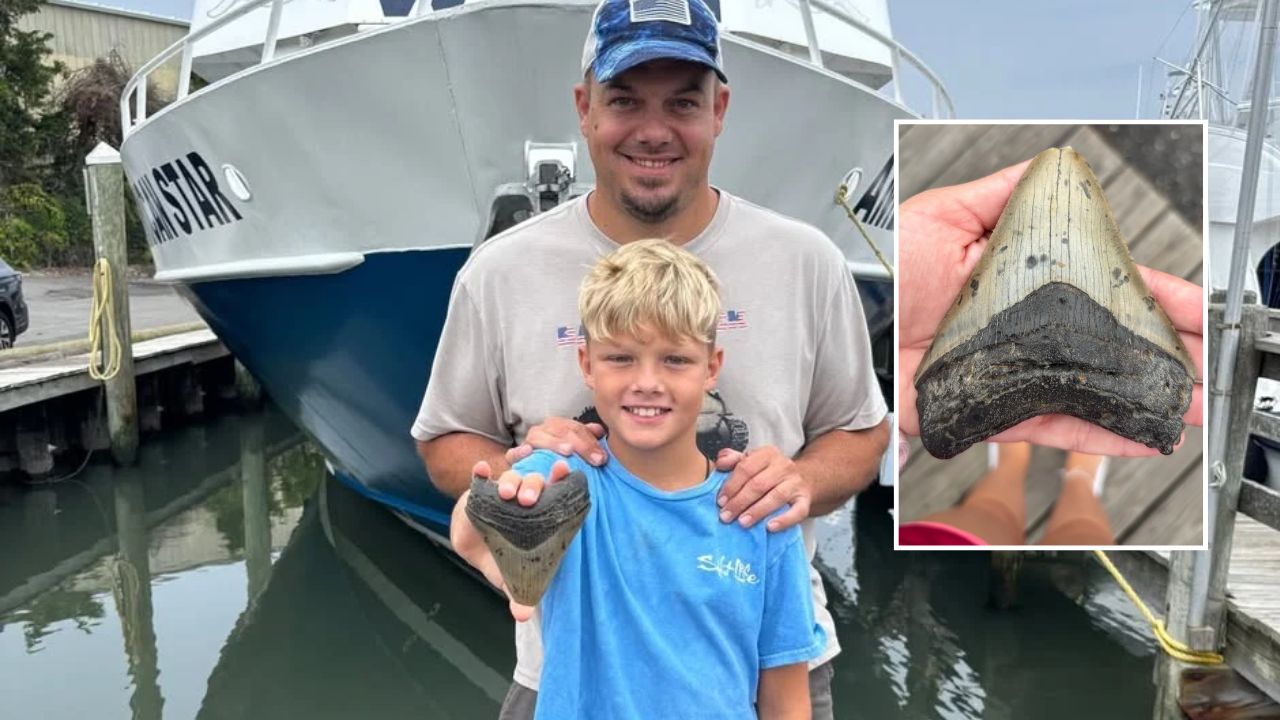
Sea Isle City, New Jersey — A Pennsylvania family’s ordinary beach outing took a prehistoric turn when a search for seashells uncovered a fossil belonging to one of the most famous predators ever to swim through Earth’s oceans.
The Bowers family was spending time on the Jersey Shore looking for interesting shells when they noticed something unusual among the rocks.
What they found was not an ordinary shell or stone. It was a fossilized megalodon tooth, a rare discovery that experts later confirmed.
Unusual Hole in Rock Leads to Discovery
The discovery began when Mike Bowers noticed something strange while examining a rock. He said he pulled a shell from the rock and noticed that it had a hole inside. That small detail quickly caught his attention.
“As I pulled a shell out of the one rock, there was a hole in the rock,” Bowers said.
When he looked closer, he realized something was lodged inside and said he was “just astonished.” However, the opening was too small for his hand, so Bowers called for his son, Bo, whose smaller hand could reach into the opening.
The family was soon holding an object that had survived for millions of years.
Expert Confirms Rare Megalodon Tooth
Rather than simply assuming what they had found, the family took the fossil to an expert connected with the Cape May Whale Watch and Research Center. The expert confirmed that the object was a megalodon tooth.
The organization described the discovery as a once-in-a-lifetime find, adding to the excitement surrounding the family’s unexpected beach treasure.
For the Bowers family, what started as a casual search for seashells had turned into an encounter with a piece of prehistoric history.
Megalodon Was One of Earth’s Largest Predators
The megalodon was an enormous prehistoric shark that lived in oceans around the world millions of years ago. The species eventually became extinct approximately 3.6 million years ago, meaning modern humans never encountered these giant predators.
Although scientists continue to study the species and debate some details about its size and behavior, estimates suggest that some megalodons may have reached around 60 feet in length.
Innocent NYC Mom of Five Dies After Stray Bullet Hits Her During Brooklyn Brawl as Police Search for Shooter
That would have made the animal one of the largest predatory sharks known to have ever lived. Its enormous teeth are among the most recognizable evidence left behind by the species.
Unlike the soft tissues of a prehistoric shark, which would not ordinarily survive for millions of years, teeth can become fossilized and remain preserved in sediment and rock.
A Beach Walk Turns Into Prehistoric Adventure
The discovery also highlights how unexpected fossils can sometimes be found in places where people are simply enjoying a day at the beach.
The Bowers family had been looking for seashells when a seemingly ordinary rock caught Mike’s attention. A small hole led to a discovery that connected the family to an animal that disappeared from Earth’s oceans millions of years before the modern era.
The megalodon tooth now serves as a remarkable reminder of the prehistoric creatures that once inhabited the same oceans surrounding today’s coastal communities.
For the family, the experience was even more memorable because they were able to uncover the fossil together.
What began as a simple beach outing in Sea Isle City ended with a rare prehistoric discovery that few beachgoers ever get the chance to make.
Would you have recognized a megalodon tooth if you found one on the beach? Share your thoughts and tell us what you would do if you made a discovery like this.