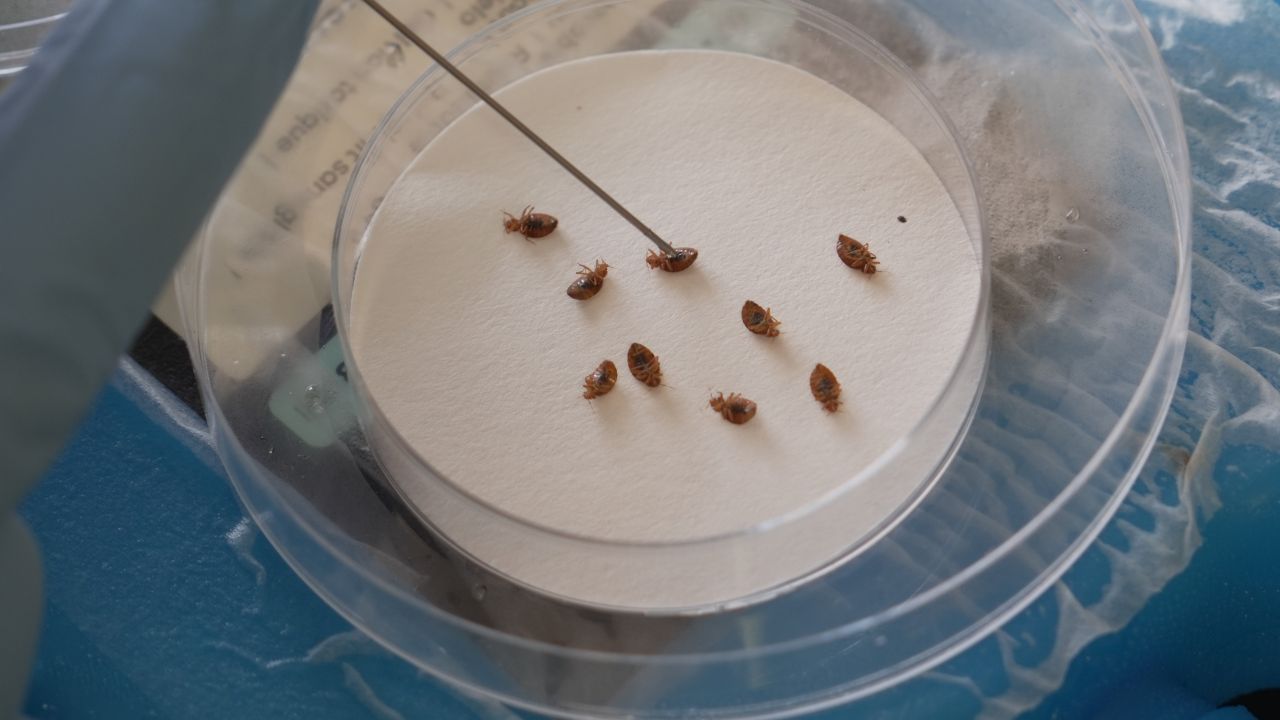
Chicago, Illinois — Bedbugs may be tiny, but their resurgence is creating a growing headache for households, travelers and pest-control professionals across the United States.
Often compared with vampires because they emerge at night to feed on human blood, the reddish-brown insects hide during daylight hours in mattresses, furniture, clothing and tiny cracks around living spaces.
Infestations can become difficult to detect because some people experience little or no reaction to bedbug bites. By the time signs become obvious, an infestation may already be widespread.
The problem historically becomes more noticeable during the warmer months, when bedbug activity tends to peak.
Scientists Are Raising New Health Concerns
For decades, experts generally considered bedbugs a serious nuisance but not a significant transmitter of infectious disease. That assumption is now being examined more closely.
A 2023 study from researchers at the University of South Dakota found that bedbugs could acquire MRSA during one feeding session and later transfer the bacteria during another feeding under laboratory conditions.
MRSA is an antibiotic-resistant bacterium that can cause difficult-to-treat infections.
Researchers caution that the experiment does not prove bedbugs transmit MRSA to humans in real-world settings. More research is needed to determine whether the insects can actually play a meaningful role in spreading the bacteria.
Still, researchers say the findings have changed how scientists view the potential public-health implications of bedbugs.
Severe Infestations Can Cause Serious Health Problems
Although most bedbug infestations are associated with itching and skin irritation, extreme cases can create much more serious consequences.
A 2020 medical case report from France described a 70-year-old man who collapsed and was later diagnosed with severe anemia caused by prolonged blood loss.
Doctors discovered bedbugs feeding on his body, while an inspection of his home reportedly found thousands of insects throughout his mattress, walls, floors and curtains.
Such cases are unusual, but they demonstrate why severe and untreated infestations should not simply be ignored.
Bedbugs Are Becoming Harder to Kill
Modern bedbugs are also presenting another challenge: insecticide resistance.
Bedbug populations declined dramatically after World War II as DDT and other chemicals became widely used. However, the Environmental Protection Agency banned DDT for most applications in the United States in 1972 because of environmental and potential health concerns.
Bedbugs had already begun developing resistance to the chemical, and researchers say resistance to modern insecticides has contributed to their resurgence.
That means simply spraying an infestation with random chemicals may not solve the problem.
Travel Can Bring Bedbugs Home
Experts say prevention is one of the most effective ways to avoid a major infestation.
Travelers should inspect hotel rooms before unpacking, paying particular attention to mattresses, bed frames and dark stains that could indicate bedbug activity.
Luggage should be kept away from beds and carpeting when possible. After returning home, travelers should unpack carefully and place clothing directly into the washing machine and dryer.
Secondhand furniture can also introduce bedbugs into a home. Experts recommend thoroughly inspecting used furniture and treating it before bringing it indoors.
Heat Can Help Eliminate an Infestation
For clothing and other washable items, experts recommend laundering them and using a high-heat dryer cycle.
Non-washable belongings may require other approaches, including carefully controlled freezing, steaming or professional heat treatment.
Professional thermal treatments can be highly effective because sustained temperatures of approximately 122 degrees Fahrenheit (50 degrees Celsius) can kill bedbugs and their eggs. However, high temperatures can damage certain belongings and should generally be handled by professionals.
The EPA also provides guidance for people attempting to manage infestations themselves, but experts warn that bedbug control requires patience and a systematic approach.
Experts Say Don’t Panic — Act Quickly
Bedbugs can be extremely difficult to eliminate, particularly when populations have developed resistance to commonly used pesticides. Professional extermination may cost hundreds or even thousands of dollars, depending on the size and complexity of an infestation.
Researchers say the most important thing is not to panic or ignore the problem. If bedbugs are suspected, acting quickly can prevent a small infestation from becoming a much larger one.
As one researcher put it, people should not simply wait and hope the insects disappear. Identifying the problem early, limiting their spread and using appropriate treatment can make the battle considerably easier.
Have you ever dealt with bedbugs at home or while traveling? What worked — or didn’t work — for you? Share your experience in the comments below.